
Building the Orbiter
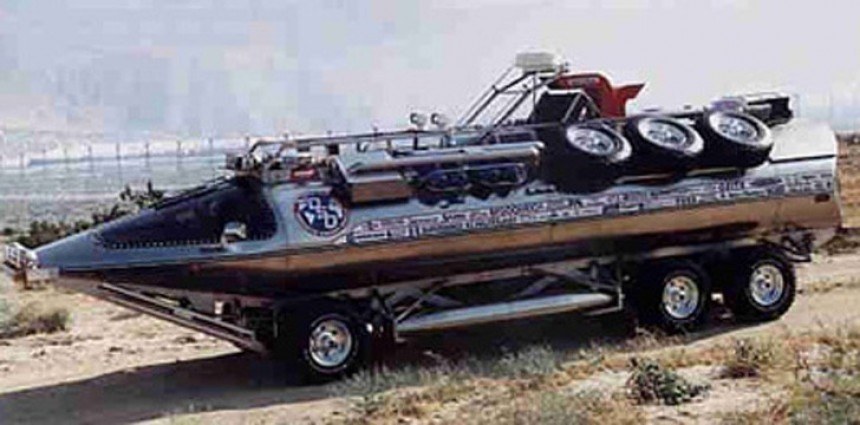
Rick Dobbertin built the Orbiter at his home in Cazenovia, New York, in a backyard garage measuring 14 by 40 ft (4.3 by 12.2 m) [1]. The starting point was a 1959 Heil stainless steel milk tanker trailer [1][2]. The double-walled tank, insulated with Styrofoam and set on a full steel frame, became the hull, and a wedge-shaped nose was added for the cockpit [3][4]. Dobbertin and his then wife, Karen, worked on it for about four and a half years. His own page gives more than 14,000 hours, while magazine reports from 1994 quoted on the same page gave shorter build times [1][4].
Power came from a 250 hp (186 kW) GM 6.5-liter turbocharged diesel V8 with a marine conversion, driving through a four-speed 4L80E automatic [1][3]. On land it used Dana axles, 16.5 in (42 cm) wheels and part-time four-wheel drive [1][3]. In water a single 22 in (56 cm) three-blade bronze propeller pushed it along [1][4]. It had one steering wheel for the road and another for the water, a 340 US gal (1,287 L) diesel tank, a bedroom, a kitchen and a toilet [3][4]. Dobbertin listed a top speed of 70 mph (113 km/h) on land and 10 knots (11.5 mph, 18.5 km/h) at sea, fuel use of 10 to 12 mpg (about 20 to 24 L/100 km) on the road and 1 to 2 mpg (about 120 to 235 L/100 km) afloat, and a loaded weight of 17,500 lb (7,940 kg) [1]. The finished vehicle was about 32.5 ft (9.9 m) long [3].
Project Earth-Trek
The voyage, called Project Earth-Trek, was meant to circle the globe [1][4]. The Dobbertins left Syracuse, New York, on December 19, 1993, drove down the East Coast to Miami and put to sea toward the Bahamas [3][4]. The builder's route list then runs through the Caribbean islands, Venezuela, Colombia, Central America and Mexico before returning to the United States and Canada [1]. The going was rough. Driving Line reports waves of 18 ft (5.5 m) and says the Orbiter capsized while docked in Puerto Rico, while Autoevolution describes a near capsize there that needed Coast Guard help, along with stops by the DEA and FBI and several major breakdowns [3][4].
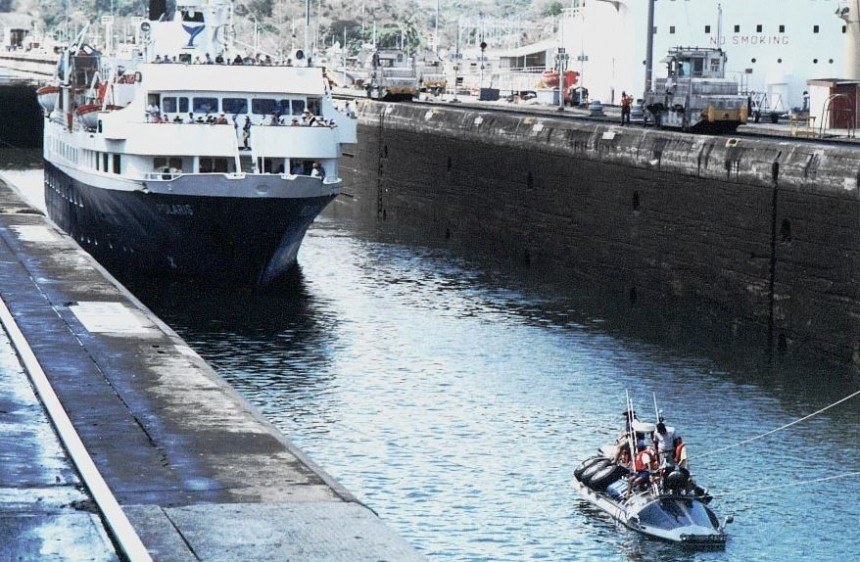
On February 21 to 23, 1995, the Orbiter passed through the Panama Canal [1]. Dobbertin calls it the first amphibious transit of the canal; his page quotes Car and Driver repeating the claim and Autoevolution later called it a record, but none of these sources names an outside body that verified it [1][4].
The money then ran out. The builder's page says the round-the-world plan ended early for lack of funding, and Autoevolution reports that by June 1996 the couple were broke and had given up on both the project and their marriage [1][4]. The journey ended in Los Angeles in 1996 [3]. By then, according to the builder, the Orbiter had visited 28 countries and 38 US states and covered more than 30,000 miles (48,300 km) on land and more than 3,000 miles (4,800 km) on the open ocean. Car and Driver, as quoted on the same page, counted 27,300 land miles (43,900 km) and 3,000 ocean miles (4,800 km) between December 1993 and June 1996 [1]. As far as the sources describe them, its sea passages ran along the Caribbean island chain toward South America and through the Panama Canal, and Driving Line says the vehicle was not up to a full ocean crossing [1][3].
Later years and the HydroCar
Dobbertin later tried to sell the Orbiter for $200,000; Autoevolution places that asking price at a 1999 auction [3][4]. A Chicago-based collector bought it in 2004 without the price being made public, and in 2022 Autoevolution wrote that its trail had gone cold since then [3][4].
Dobbertin's next amphibian was the HydroCar, a two-seat sports car meant to double as a speedboat [5][6]. Built over about ten years, it had a stainless steel space frame with an aluminum body and a 572 cu in (9.4 L) Chevrolet big-block V8 rated at 762 hp (568 kW). Pontoons drop down in water mode and form the fenders on land [5][6]. It was featured in Popular Mechanics in 2004, and video posted by the builder suggests its first water run came around April 2010 [5][6]. The Drive and Jalopnik both doubted its claimed top speeds of 125 mph (201 km/h) on land and 60 mph (97 km/h) on water, and The Drive found no video of it planing [5][6]. It sold through Worldwide Auctioneers in 2018 for $60,500 and was offered at Barrett-Jackson in June 2021 [5][6].
Photos
Related entries
Sources
- Dobbertin Surface Orbiter, Dobbertin Performance (builder's site). www.dobbertinperformance.com/orbiter
- Dobbertin Surface Orbiter, Wikipedia. en.wikipedia.org/wiki/Dobbertin_Surface_Orbiter
- The Dobbertin Surface Orbiter Was A Globe-Trotting, Hand-Built, Amphibious Milk Tanker (Benjamin Hunting), Driving Line (2019-08-19). www.drivingline.com/articles/the-dobbertin-surface-orbiter-was-a-globe-trotting-hand-built-amphibious-milk-tanker
- Remembering the Dobbertin Surface Orbiter, the Amphibious Custom Build That Wrote History (Elena Gorgan), Autoevolution (2022-12-11). www.autoevolution.com/news/remembering-the-dobbertin-surface-orbiter-the-amphibious-custom-build-that-wrote-history-206060.html
- The 762-HP Hydrocar Could Be Your Ticket to Amphibious Adventure (Lewin Day), The Drive (2021-06-14). www.thedrive.com/news/41088/the-762-hp-hydrocar-could-be-your-ticket-to-amphibious-adventure
- This One-Off Amphibious Speedboat Has A 762-HP V8 And It's For Sale Again (Mercedes Streeter), Jalopnik (2021-06-16). www.jalopnik.com/this-one-off-amphibious-speedboat-has-a-762-hp-v8-and-i-1847113062
Last reviewed November 2026. Spotted something to correct or add? Tell us and include a source.
About the Amphibious Encyclopedia
WaterCar has designed and built amphibious vehicles in Southern California for more than 25 years. We keep this encyclopedia so anyone curious about vehicles that cross between land and water has one place to start, with the sources listed for every fact.
Browse all entries → · The WaterCar machines → · How a WaterCar works →