
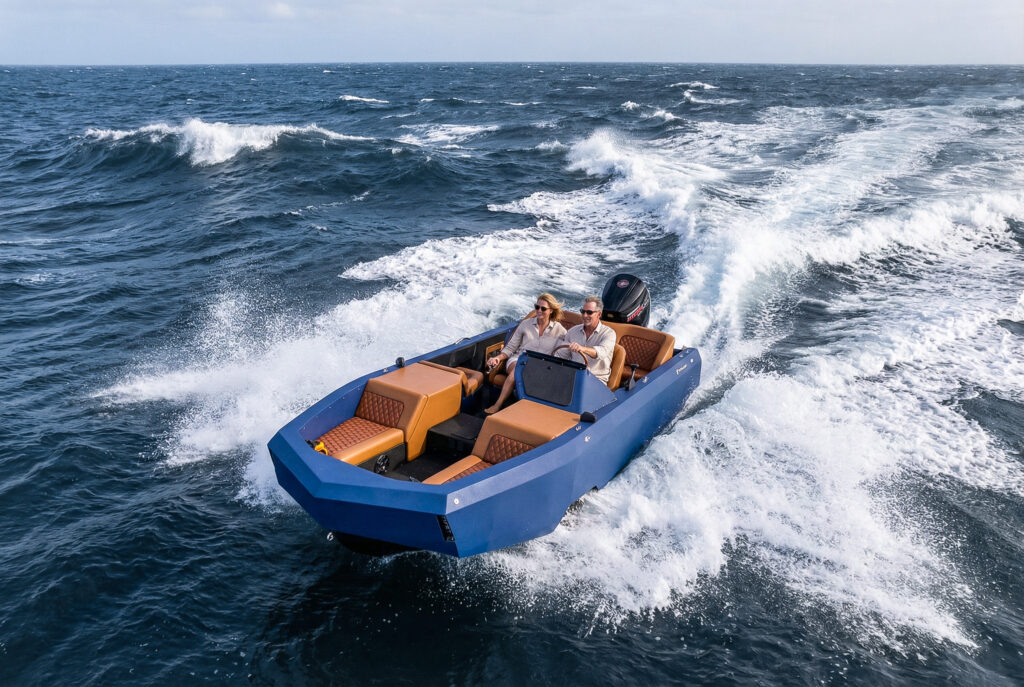
Street legal. Coast Guard compliant. Both.
Plenty of amphibious vehicles can drive into the water and drive back out. Doing both for real is something else: a vehicle you can register and drive on public streets that is also a real boat, built to the same federal safety standards as any boat at the dock. That is what WaterCar builds.
The WaterCar EV is the only amphibious vehicle sold new today that its maker certifies both for the street and as a boat.
- Street legal as soldCertified by WaterCar under Federal Motor Vehicle Safety Standard 500, with its own 17-digit vehicle identification number (VIN).
- U.S. Coast Guard compliantBuilt to the U.S. Coast Guard’s safety standards for recreational boats, with its own Hull Identification Number (HIN).
- NMMA certifiedIndependently inspected to ABYC standards, for the 2026 model year.
- A real boat on the waterAn all-welded aluminum hull that planes like any powerboat.
Checked November 2026. The WaterCar EV is sold as the WaterCar Adventure and the WaterCar Signature. To check the statement, WaterCar reviewed every amphibious vehicle it could find on sale new in 2026 against both parts of the test set out in our guide to the types of amphibious vehicles, and found no other vehicle that leaves its maker certified for both.
- Since 1999building amphibious vehicles
- 28amphibious patents
- 2010Guinness World Records title for the WaterCar Python
- 2026NMMA certified model year
A VIN and a HIN: certified as a car and as a boat
A WaterCar is held to two complete sets of rules, and it carries the proof of both: a vehicle identification number for the road and a Hull Identification Number for the water.
Street legal
Today’s WaterCar leaves our shop certified as a street-legal vehicle under Federal Motor Vehicle Safety Standard 500, the federal standard for low-speed vehicles (LSVs), and it carries its own 17-digit VIN. That means real road equipment: headlights, turn signals, brake lights, mirrors, seat belts and a parking brake. Owners register it with their state, like any other road vehicle, wherever LSVs are allowed.
Read what an LSV is and find the LSV and boat rules for your state.
U.S. Coast Guard compliant
On the water a WaterCar is a boat in every legal sense. It is built to the U.S. Coast Guard’s safety standards for recreational boats and carries its own HIN. NMMA, the marine industry’s independent certification program, goes beyond the Coast Guard minimum: it inspects the model against ABYC standards every model year and lists WaterCar as certified for 2026. NMMA certification is not required by law. WaterCar does it anyway.
The Coast Guard sets the standards, builders certify that each boat complies, and NMMA checks that they do. What NMMA certification covers.
For owners outside the United States, the boat side is CE certified, and road use is arranged locally, market by market.
Street-legal registration and operating rules for low-speed vehicles vary by state and local jurisdiction and may change. Confirm current requirements with your state DMV and local authorities before registering or operating a WaterCar on public roads.
Why it is so rare
Each set of rules pulls the design a different way, and a vehicle that meets both has to win every one of those arguments at once.
- The road adds equipment and weight. A street-legal vehicle needs lights, signals, mirrors, seat belts, brakes and a federal certification before it is sold.
- The water punishes weight. To plane, a hull has to climb up and skim across the surface. Every pound of axles, suspension and batteries is weight it has to lift, and a body shaped for the road is not shaped for waves.
- A boat has its own rulebook. Capacity, flotation, fuel and electrical systems have to meet the Coast Guard’s standards, and NMMA’s inspection adds bilge pumps, navigation lights, steering and more.
- Changing worlds has to be simple. The wheels have to get out of the water’s way, and the drive has to change from road to water without a trailer or a launch crew.
That is why most builders choose one world. Floaters keep the car and accept a slow crossing. Land crawlers keep the boat and accept a short crawl up the beach. Both are sound choices for what their owners need.
WaterCar chose both, and it starts with the boat: a 19.5-foot all-welded aluminum unibody with a V-bottom hull, reverse chines and foam-filled flotation. On the water a Mercury Pro XS 115 outboard puts it on plane. On land a separate electric drive takes it down the street, and LaunchMode hydraulics raise the road wheels for the water. It took more than 25 years and 28 patents to get here. See how it works, the engineering and the full specifications.
Three ways to build an amphibious vehicle
An amphibious vehicle is a vehicle that can travel on land and on water under its own power, without being carried or towed between the two.
Most amphibious vehicles are at home in one world and visitors in the other. Some are floaters: cars and trucks that drive well on land, then float across the water at about 6 mph (9 km/h). Others are land crawlers: real boats that run fast on the water, then crawl up the beach at about 6 mph (9 km/h). A few are dual-mode: they plane on the water and drive on the street. Floaters and land crawlers do what they were built for. They are just not dual-mode.
- Land-first (floater)A land-first amphibian is an amphibious vehicle that travels on water without planing or riding on hydrofoils. It is also called a floater: a car that floats.
- Water-first (land crawler)A water-first amphibian is an amphibious vehicle that planes or rides on hydrofoils on water and does not exceed 20 mph (32 km/h) on land. It is also called a land crawler: a boat that crawls.
- Dual-modeA dual-mode amphibian is an amphibious vehicle that planes or rides on hydrofoils on water and exceeds 20 mph (32 km/h) on land.
Today’s WaterCar is a dual-mode amphibian, and it goes one step further: it is certified for both worlds. No type is better than another, and the builders of all three have moved the idea forward. Every vehicle, the tests and a chart of 279 vehicles are in the guide to the types of amphibious vehicles.
Since 1999: six machines, one idea
Dave March founded WaterCar in Southern California in 1999. In more than 25 years the company has built six generations of amphibious machines, each one teaching the next, and it holds 28 amphibious patents.
 Sports Car
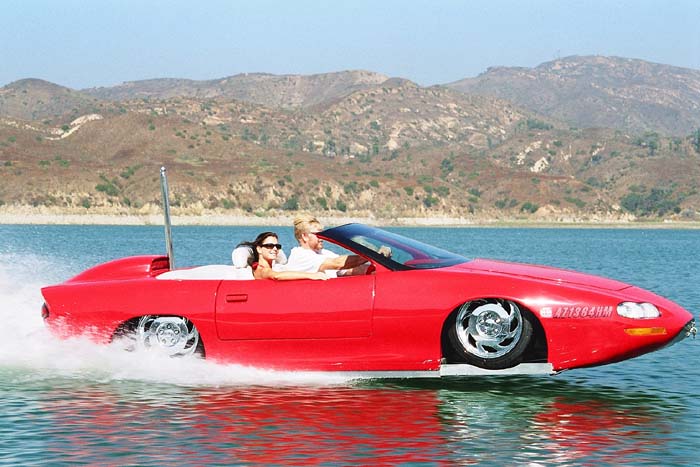
The first prototype: a fiberglass body, a Subaru engine, jet propulsion on the water and hydraulically retracting wheels.
 Gator
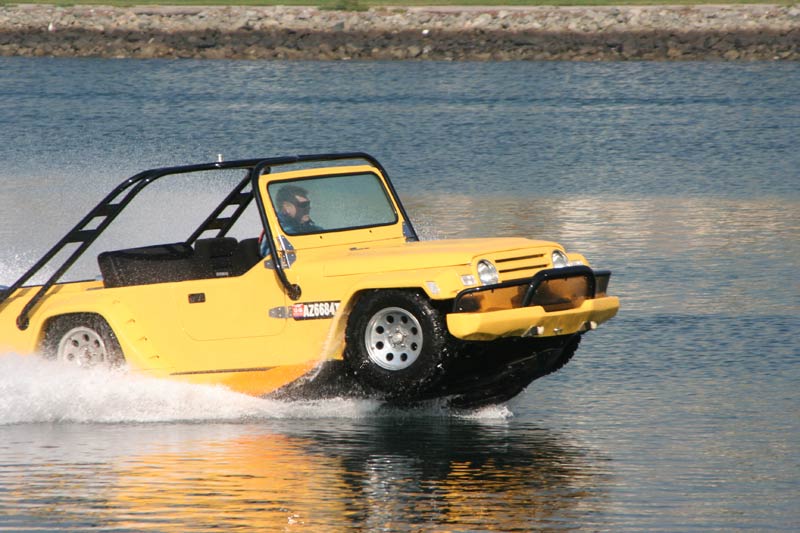
A rugged, go-anywhere design built on a Volkswagen engine and chassis.
 Python
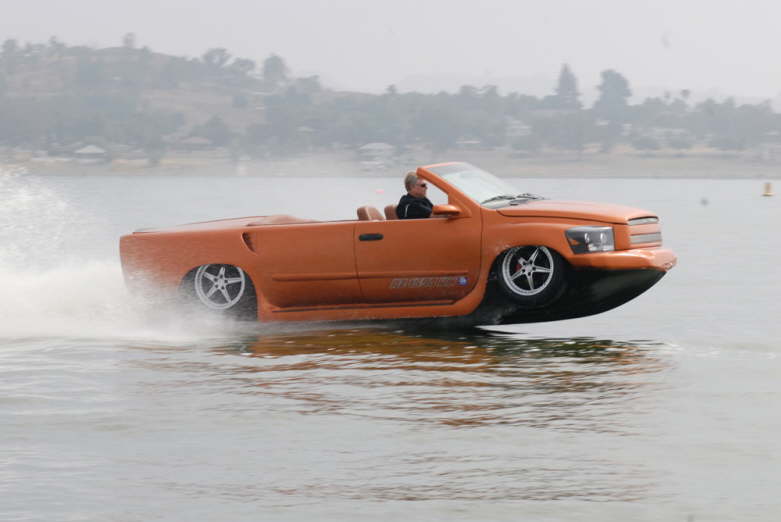
The performance chapter, with a Corvette LS-series V8 and a water jet. In 2010 Guinness World Records named it the world’s fastest amphibious car, and WaterCar later timed it at 72 mph (116 km/h) on water and 122 mph (196 km/h) on land.
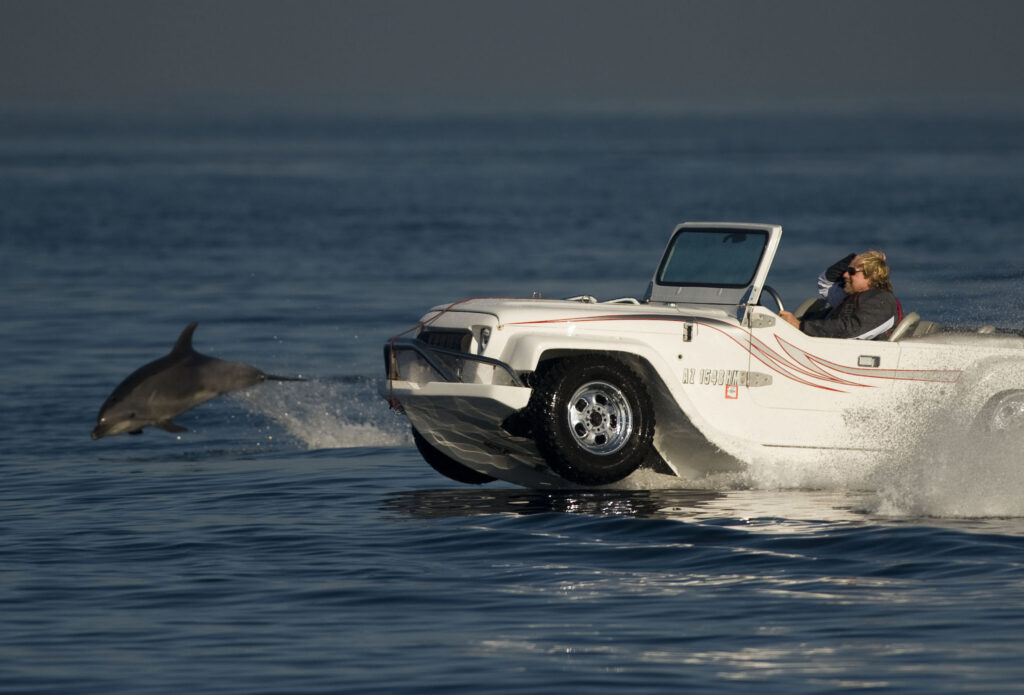 Panther
The first WaterCar offered to the public, launched in 2013. In 2014 Dave March drove one from the shop into Newport Harbor and about 30 miles across the open Pacific to Catalina Island.
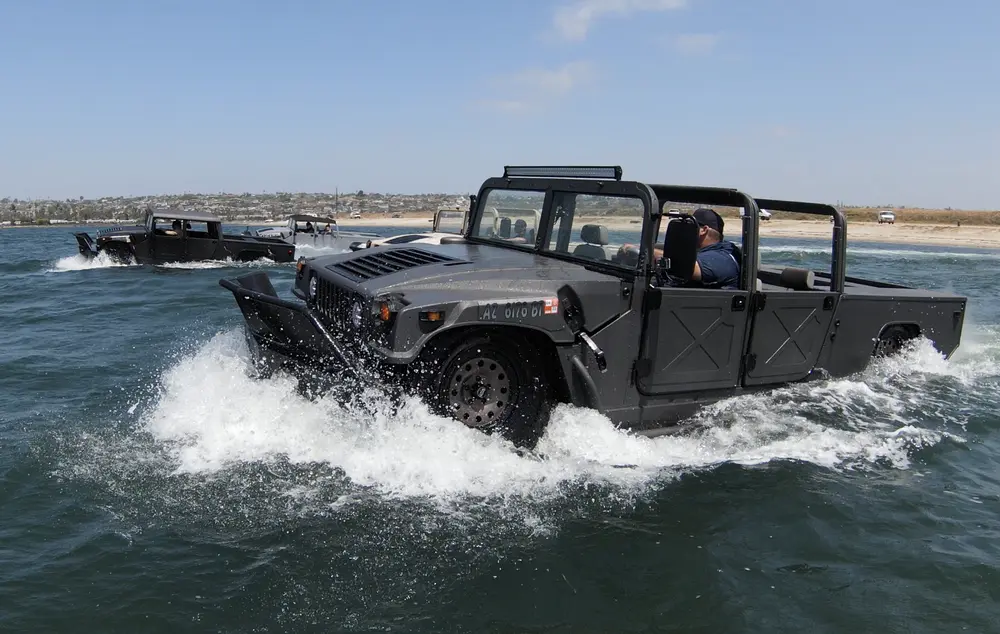 H1
An aluminum body and a 430 hp Chevrolet LS3 V8. It taught WaterCar to work with the material its boats are built from today.
- WaterCar EV
Today’s WaterCar, and the one that brings it all together: street legal on land and a U.S. Coast Guard compliant, NMMA certified boat on the water. Sold as the Adventure and the Signature.
Follow all six through the history of amphibious vehicles, where WaterCar appears from 1999 to today, or see them side by side on the WaterCar machines page.
Questions people ask
Is a WaterCar street legal?
Yes. Today’s WaterCar is certified by WaterCar as a street-legal low-speed vehicle (LSV) under Federal Motor Vehicle Safety Standard 500, and each one has its own 17-digit vehicle identification number. Owners register it with their state where LSVs are allowed. Rules differ by state, so check yours before you drive.
Is a WaterCar Coast Guard compliant?
Yes. It is built to the U.S. Coast Guard’s safety standards for recreational boats and carries its own Hull Identification Number. It is also NMMA certified to ABYC standards for the 2026 model year, an independent inspection that goes beyond the Coast Guard minimum.
Is a WaterCar a real boat?
Yes. It is built as a boat first, with an all-welded aluminum hull and foam-filled flotation, and on the water it planes like any other powerboat.
Where can I drive a WaterCar?
On public roads where your state and town allow low-speed vehicles, and on the water like any boat of its size. Owners drive from home to the water, drive straight in and drive home again, with no trailer. Rules differ by state, so check the WaterCar state LSV and boat registration guides.
What is a dual-mode amphibian?
A dual-mode amphibian is an amphibious vehicle that planes or rides on hydrofoils on water and exceeds 20 mph (32 km/h) on land. Today’s WaterCar is one, and it goes further: it is certified for both worlds.
What makes WaterCar different from other amphibious vehicles?
Most amphibious vehicles are built for one world and visit the other. Today’s WaterCar is a car and a boat: street legal on land, and a U.S. Coast Guard compliant boat that planes on the water. The WaterCar EV is the only amphibious vehicle sold new today that its maker certifies both for the street and as a boat. (Checked November 2026.)
Choose your WaterCar
Build and price your WaterCar, compare the models or see every specification.
Sources
- Federal Motor Vehicle Safety Standard 500 (49 CFR 571.500), Legal Information Institute
- Boating safety regulations for boat manufacturers, U.S. Coast Guard Office of Auxiliary and Boating Safety
- NMMA certified boat manufacturers, National Marine Manufacturers Association
Published November 15, 2026 by WaterCar. WaterCar facts are from WaterCar specifications and WaterCar’s NMMA certification.